A motor superyacht at anchor at dusk, seen from above

AI assistant for one yacht's documents

The AI agent that knows your vessel and does the work.

YACHT AGENT reads your yacht's manuals, drawings, emails and PMS and answers questions from them, like an engineer who has read every page. It also drafts the reply, the requisition and the fault checklist, and waits for your approval.

Runs on board, works offlineEvery answer shows document and pageNothing is sent without your approval
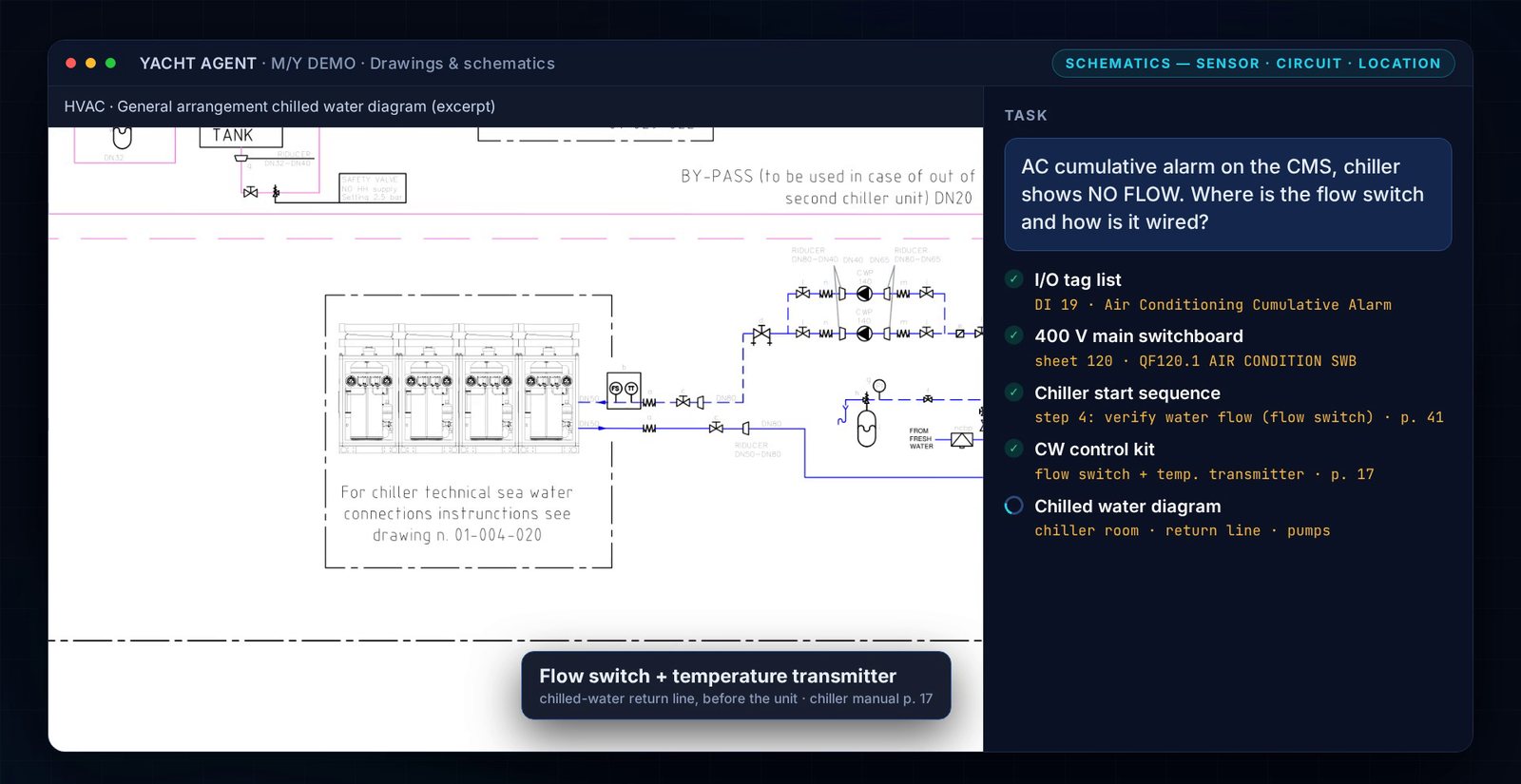
Agent interface: the question on the right, the steps with sources, and the chilled-water diagram with the flow switch highlighted

In service on a 37 m superyacht.1,532 manuals and drawings295 equipment items179 maintenance tasks taken from the manuals

How it works

One agent, built around your yacht.

Not a general chatbot. Software installed on board that knows this vessel's engines, switchboards, contractors and history.

It knows your documents

Shipyard folders, manuals, drawings, mail and PMS are sorted into the vessel's systems and indexed page by page. The agent answers only from them, never from memory.

You ask, it shows the page

Type a question as you would ask a colleague. The answer comes with the document and the page it was taken from, so you can check it in seconds.

It does the work, you approve

Replies to contractors, requisitions, requests for quotation and fault checklists arrive drafted. A named person approves before anything is sent or filed.

YACHT AGENT · M/Y DEMO
Oil quantity for the main engines at change, with filters?
90 litres per engine at change with filters. Sump range 70–90 litres.MAN D2862 maintenance manual · section 11.6
Chiller shows NO FLOW. Where is the flow switch and how is it wired?
On the chilled-water return line, before the unit, together with the temperature transmitter. Alarm input DI 19, supply from QF120.1. Checklist below, in order.chiller manual p. 17, 41 · switchboard sheet 120 · chilled water diagram
What did the refrigeration contractor quote after the inspection, and what is still open?
Inspected 10 Oct: both condensers and one sea-water pump. A quote for a custom condenser was promised, prices not yet received. Reply drafted asking for the condenser, cleaning and pump priced separately.6 emails · 2 attachments · draft awaiting your approval
Ask about any system, document or email on board

Just ask

Plain questions. Answers you can check.

Numbers, set points, procedures, part numbers, who said what in a thread. If the answer is not in the documents, the agent says so instead of guessing.

  • Works on a laptop in the ECR and on your phone around the vessel.
  • Opens the drawing or the manual page, not just a text answer.
  • Reads whole email threads and attachments, not only the last message.

Getting started

Set up remotely. Two to four weeks.

Nobody flies in. We work on the vessel's documents where they are and hand over a working agent.

  1. 1

    Remote access to a PC on board

    You give us remote access to a workstation on the vessel, under NDA. The documents, the mail archive and the PMS are already there. Nothing to send.

  2. 2

    We build the knowledge base

    Every file sorted into the vessel's system tree: group, system, equipment, model. Scans made searchable, every page indexed with its source. Maintenance tasks pulled from the manuals for your PMS.

  3. 3

    The agent goes live on board

    Installed remotely on the on-board unit, connected to mail and PMS. One-hour briefing for the crew by video call. New documents are added as they arrive.

YOUR DOCUMENTSKNOWLEDGE BASEAGENT Manuals Drawings Mail · quotes PMS exports Reports · logs Yard folders 1 Machinery ├ Main engines └ MAN D2862 Maint. manual · p. 35 Parts catalogue · p. 112 └ Chillers Chiller manual · p. 17, 41 7 Electrical └ 400 V switchboard Schematic · sheet 120 Mail · history └ Contractor threads 6 emails · 2 attachments every page indexed with its source Your questionin plain words Finds the pagesby meaning, not keyword Reads themmanual · drawing · mail Answer + pageor drafted reply, RFQ You approvenamed · logged

Every answer points back to a page in this tree. Nothing comes from memory.

Who it's for

One agent. Each role asks its own questions.

Captain

Class and flag correspondence, survey history, certificates, a status for the owner's office in minutes.

"What did class ask for at the last annual, and what is still open?"

Chief Engineer and ETO

Manuals, schematics, troubleshooting, requisitions, maintenance tasks from the manuals into the PMS.

"Torque for the cylinder head bolts, with the tightening sequence."

Technical Superintendent

What the contractor quoted, what was agreed, what remains open, across several vessels, without reading every thread.

"Summarise the refit correspondence with the yard since March."

Management company

Knowledge survives crew change. One document structure across the fleet, one place to check what was agreed.

"Which vessels have the 10-year survey due in the next 12 months?"

What changes

Fewer call-outs. The right parts. Hours back every week.

For the owner's office and the management company

  • Fewer contractor call-outs. A fault that is described in the manual and shown on the schematic gets found on board.
  • The right part the first time. Part numbers come from the catalogue, quantities from the service scope. No second order, no express freight.
  • Less downtime. A fault traced in minutes instead of a day does not cost a charter day.
  • Nothing lost at crew change. The history stays on the vessel, not in someone's inbox. Nothing is re-ordered, re-quoted or re-inspected.
  • More vessels per superintendent. The same technical office follows more correspondence and more PMS data with the same people.

For the captain, the engineers and the superintendent

  • Hours back every week. Finding the page, reading the thread and drafting the reply is done before you sit down.
  • Answers in a minute, with the source. The page is open, not a search started.
  • Requisitions and RFQs ready for review, not typed line by line.
  • Thread summaries instead of re-reading. What was inspected, what was quoted, what is pending.
  • Handover built in. The new engineer asks the vessel, not the previous chief.

Local or Standard

Your documents stay on the yacht.

Same agent, same knowledge base. The difference is where the heavy computing runs and what hardware goes on board.

Local

Everything on board. No connection needed.

Fully offline
ON BOARD Knowledge base manuals · drawings mail · PMS · logs Agent reads · drafts You approve · send NO CLOUD No internet needed. Nothing leaves the ship.
Runs on
A dedicated workstation installed on the vessel
Connectivity
None required. Works at sea and in remote areas
Data
Never leaves the ship
Best for
Strict data policies, long passages, owners who want nothing off board

Standard

Compact unit on board, heavy work over an encrypted link.

Compact hardware
ON BOARD Knowledge base manuals · drawings mail · PMS · logs Compact unit agent · search ENCRYPTED Secure compute ashore region in contract no training on data Out, encrypted: the question and the text it needs. Back: the answer.
Runs on
A compact unit on board plus secure compute ashore
Connectivity
Encrypted link when online. Archive and search stay available on board
Data
Archive on board. Processing encrypted, region agreed in the contract
Best for
Most vessels, fleets and management companies

You can start with Standard and move to Local later. The knowledge base moves with you.

Data privacy

Confidential by design.

A yacht's archive holds the owner's affairs, contracts and crew correspondence. The agent is built to keep it that way.

No training, no sharing

Your documents are never used to train models and never shared with third parties. Owner, vessel and crew names can be masked. Deleted on request, with confirmation.

Approval before action

Emails, requisitions and PMS changes wait for a named person to approve. The agent drafts; people send.

Demo

Four minutes, five jobs, on a real vessel's documents.

Email, documents, manuals and parts, troubleshooting with schematics, a requisition. Watch the agent work, step by step.

0:43Email1:11Documents and PMS1:29Manuals and parts1:58Troubleshooting2:17Electrical schematics2:47Requisitions

Sound on. Full HD version available on request.

Book a demo

See it on your vessel's documents.

Thirty minutes. Send a few of your own manuals or drawings and we show the agent working on them, under NDA.

Or write directly:[email protected]We reply within one working day.

No newsletter. We use your details only to arrange the demo.